Snowflake Stored Procedure
The Snowflake Stored Procedure transfer object calls a stored procedure in the Snowflake AI Data Cloud. Input parameters, return values, and, if applicable, a result set can be used as destinations or sources within the connection.
Dialog Overview
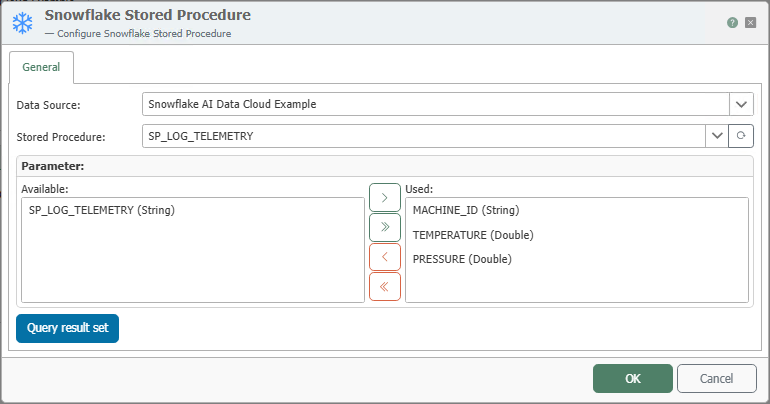
General Properties
| Property | Description |
|---|---|
| Data Source | All Snowflake connections created in the Plug-ins section are available for selection here. If the desired connection does not yet exist, you can make it available in the Plug-ins section as the “Snowflake AI Data Cloud” plug-in. |
| Stored Procedure | Stored procedure to be executed. |
| Columns/Parameters | Input and return parameters of the procedure that are to be connected as sources or destinations to the transfer object. |
| Query Result Set | If return values are expected in the form of a result set, they can be read using Query Result Set and then made available as a source on the transfer object. |
Special Features in the OPC Router
- The OPC Router reads the available parameters of the procedure and makes them available as usable elements in the transfer object.
- When
Query Result Setis executed, the OPC Router calls the procedure once to determine the structure of the result set. This call takes place within a transaction, which is subsequently rolled back. - To determine the structure, the OPC Router calls the procedure with default parameters (
NULL; for parameters that do not allowNULL, e.g.,0for numeric values or an empty string for character strings).
The procedure must be transaction-safe and must not return any errors during the standard call for structure detection.
Example
The following stored procedure writes a telemetry measurement value to the MACHINE_TELEMETRY table and returns a status based on the temperature. The transfer object shown above is configured for this procedure.
CREATE OR REPLACE PROCEDURE PRODUCTION.SP_LOG_TELEMETRY(
    MACHINE_ID  VARCHAR,
    TEMPERATURE FLOAT,
    PRESSURE    FLOAT
)
RETURNS VARCHAR
LANGUAGE SQL
AS
$$
BEGIN
    INSERT INTO MACHINE_TELEMETRY (MACHINE_ID, TEMPERATURE, PRESSURE, INGESTED_AT)
        VALUES (:MACHINE_ID, :TEMPERATURE, :PRESSURE, CURRENT_TIMESTAMP());

    IF (:TEMPERATURE > 80) THEN
        RETURN 'WARN_HIGH_TEMP';
    ELSE
        RETURN 'OK';
    END IF;
END;
$$;
In the transfer object, you bind the three input parameters (MACHINE_ID, TEMPERATURE, PRESSURE) as targets; the return value is available as a source. The procedure is transaction-safe: During the standard call for structure recognition, only a data record with default values is inserted and then rolled back, and OK is returned.