SAP® Plug-in
Note: If you want to use load balancing, you need an Enterprise license.
You configure the following properties in the SAP® plug-in configuration:
"General" Tab
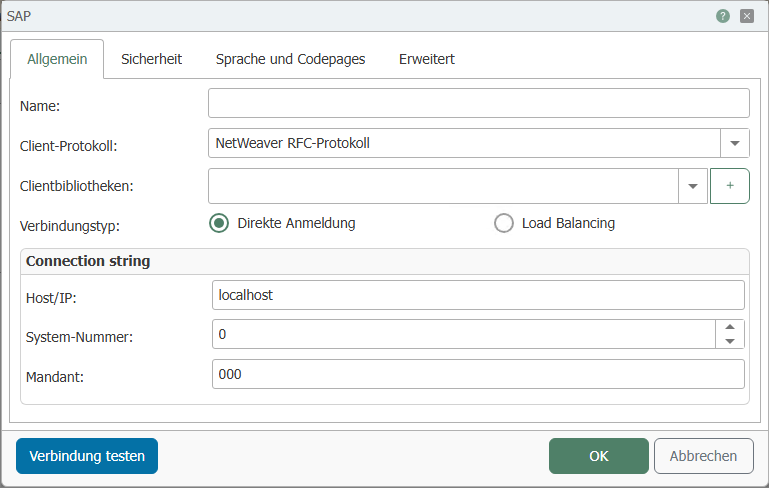
| Property | Description |
|---|---|
| Name | Any name under which this SAP® system appears in the connection configuration. |
| Client Protocol | SAP driver used by the OPC Router for communication. Select the client protocol from the drop-down menu:
|
| Client Libraries | Add the *.dll files for Windows here and the *.so files for Docker. |
| Connection Type | Select the desired authentication method:
|
Direct login:

| Property | Description |
|---|---|
| Host/IP | Server (name or IP) hosting the SAP® application system. Explicit login to a system is required (no load balancing). |
| System Number | Number of the SAP® system. |
| Client | Client (company code for the SAP® user). |
Load Balancing:

| Property | Description |
|---|---|
| Message Server | Name or IP address of the SAP® message server. |
| Log-on Group | Log-on group of the SAP® system. |
| System Number | Number of the SAP® system. |
| Client | Client (company code for the SAP® user). |
"Security" tab
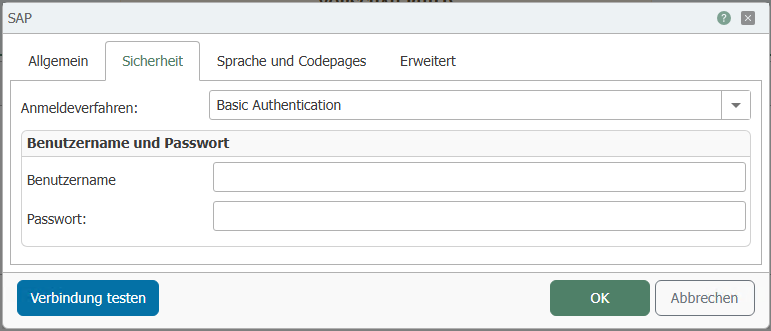
| Property | Description |
|---|---|
| Authentication Methods |
|
Basic Authentication:
| Property | Description |
|---|---|
| Username | Username for logging in to the SAP® system. |
| Password | Password for logging in to the SAP® system. |
Secure Network Communications (SNC):
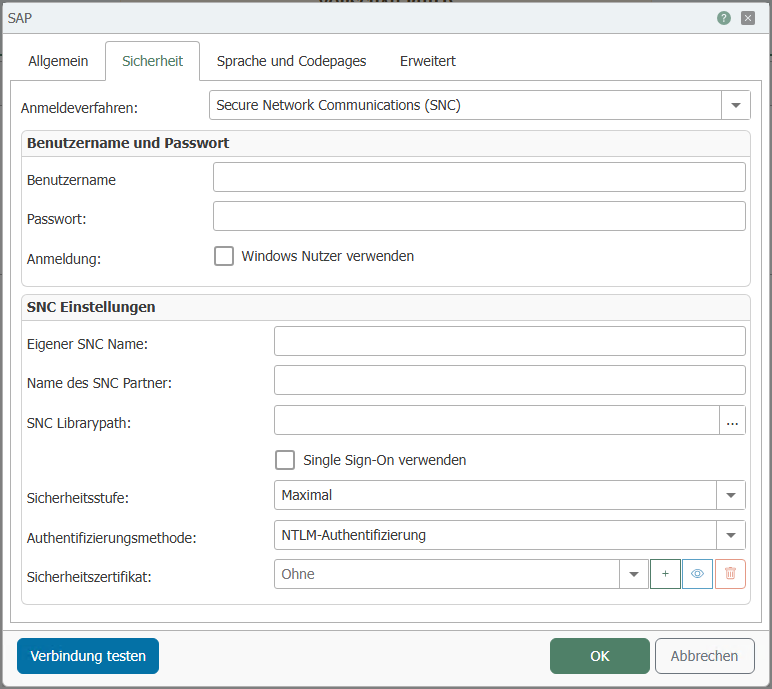
Contact Support if you want to use sapcrypto.dll.
The sapcrypto.dll file is not provided by inray.
| Property | Description |
|---|---|
| Username | Username for logging in to the SAP® system. |
| Password | Password for logging in to the SAP® system. |
| Login | Use your Windows username to log in to the SAP® system. |
| Property | Description |
|---|---|
| Own SNC Name | Name in the format p:CN=... as found in the issued certificate. |
| Name of the SNC Partner | Entry for the SNC partner in the format: p:CN=... |
| SNC library path | The SNC library path can be configured here. It can be selected in a dialog box after clicking the ‘…’ button. |
| Use Single Sign-On | Full access to all systems with a single sign-on |
| Security Level | Select the security level from the drop-down menu, e.g., Maximum or Standard. |
| Authentication method | Choose between NTLM authentication or Kerberos5 authentication. |
| Security certificate | Select a security certificate from the drop-down list. Use the plus sign to add another certificate, and the minus sign to remove one. Another button allows you to view the properties of an existing certificate. |
“Language and Code Pages” tab
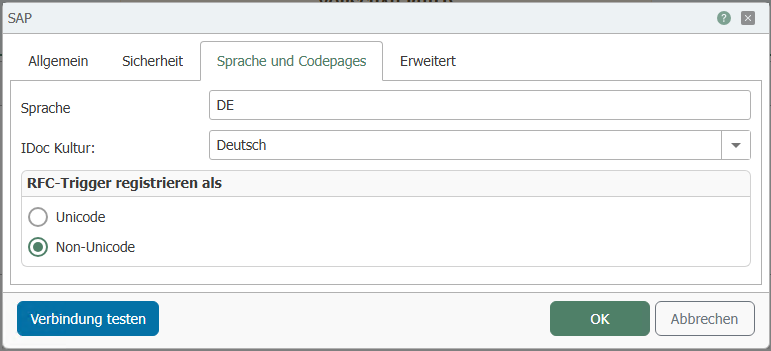
| Property | Description |
|---|---|
| Language | Enter the language you want to use here. For example, “de” stands for German, “en” for English, and so on. The language you want to use must be available on the SAP system. |
| IDoc Culture | Select the IDoc language (Culture) as German or English to prevent a crash if an instance in the SAP® plugin contains an invalid IDoc culture. The date format differs, for example: February 1 is written as 01.02.2018 in German and 02.01.2018 in English |
Register RFC Trigger as
| Property | Description |
|---|---|
| Unicode | Register RFC Trigger as Unicode |
| Non-Unicode | Register RFC Trigger as Non-Unicode |
If you are using SAP NetWeaver, the Unicode setting must always be enabled. If you are using the RFC protocol, the encoding depends on the librfc32 file. There is one version without Unicode (librfc32) and one with Unicode (librfc32u).
The target in the SAP transaction SM59 must also be set to Unicode or Non-Unicode, depending on the router settings and which library is being used.
“Advanced” tab
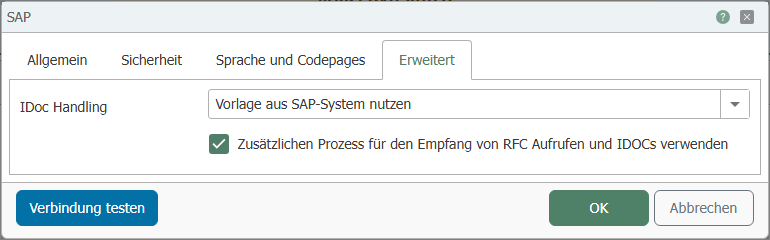
| Property | Description |
|---|---|
| IDocHandling |
|
| Use an additional process for receiving RFC calls and IDocs | If this checkbox is selected, the OPC router will not stop and will continue to run even if an error occurs in the SAP trigger (RFC or IDoc). |
You can use the “Test” button to verify that your connection is successful.
Note: To use the preferred settings of the SAP user, the OPC Router requires read access to the SAP table USR01
Configuring the Port Used
By default, the OPC Router uses the port “33_<System-Nummer>_” to communicate with the SAP system—for example, “3301” if the system number is set to 01. If the SAP® system uses a different port and the SAP® GUI is not installed, the port must be adjusted:
-
Create a backup copy of the file C:\Windows\System32\drivers\etc\services.
-
Open the file C:\Windows\System32\drivers\etc\services with a text editor (not the backup copy).
-
Modify or add the “sapgw00” entry, specifying the port number in the “XX00” format, for example, “3600.”
sapgw00 <port>/tcp -
Save the file.
The OPC Router will then use the specified number.