OPC Classic connections
We are currently unaware of any sources of error that restrict access to local OPC servers. However, accessing distributed OPC servers does present some pitfalls.
Connection cannot be established – remote only
The property “OPC Server” returns <error browsing opc-servers>.
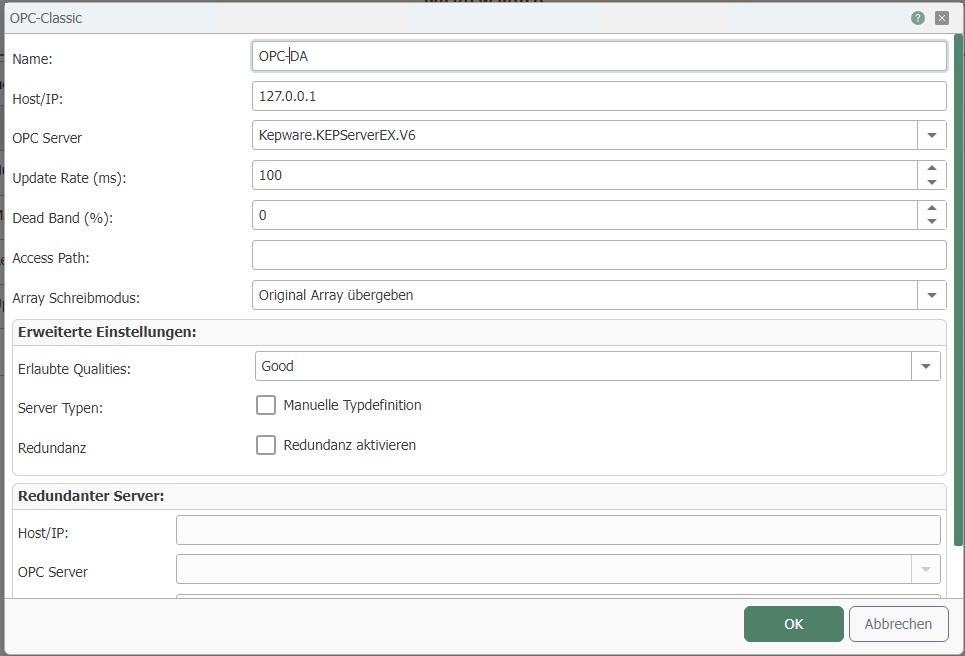
Check whether the DCOM configuration is correct:
- Is the configuration environment running under the same user account that has DCOM access to the OPC server?
- Are both the OPC Enum and OPC Server components enabled for the user on the target computer?
- Is DCOM enabled in general on the target computer?
- Do the firewalls on the relevant computers allow DCOM communication—specifically, port
135and the dynamic port range on the OPC computer? To troubleshoot, you may temporarily disable the firewall; be sure to re-enable it immediately afterward and configure the necessary permissions. - Of course, the target computer is turned on and accessible!
The connection is established, but the OPC connection does not appear in the OPC transfer object.
The OPC server was successfully connected in the configuration, but the OPC connection does not appear in the flow configuration within the OPC transfer object, or an error is returned.
- You must save the OPC connection using the “OK” button before it becomes available.
Tag Browser cannot connect to the OPC server
If the OPC connection was configured without any issues, check whether the OPC server has just been manually shut down or is being reinitialized.
- Is the computer running the OPC server powered on and accessible?
No data transfer occurs at runtime
The connection was established without any problems at design time. No data transfer occurs at runtime. Check the message in the event log or in the log file—the message text will indicate which of the three cases applies.
An item could not be registered; the message mentions "E_INVALID_ITEM_NAME."
The router displays this error message in German in every installation language. Therefore, even on an English installation, search for “konnte nicht angemeldet werden” or the error code “E_INVALID_ITEM_NAME.”
- You have likely misspelled the item name, or your OPC server is not correctly interpreting the Access Path property stored in the OPC connection. Select the item using the tag browser and/or configure a connection without an Access Path as a test. Check whether your OPC server is running properly.
The message reads “Timeout connect OPC Server!.”
- In distributed systems: Is the computer running the OPC server powered on and accessible?
The connection to the OPC server could not be established; the message states "CoCreateInstanceEx:."
The router displays this message in English regardless of the installation language; therefore, on a German installation, look for “could not be established.”
- If the connection works at design time, it is likely that the router configuration is running under the correct user, but the router service is not. Check whether the router service is running under a user who has DCOM permissions on the OPC machine.
The text following CoCreateInstanceEx: is provided by Windows itself; it appears in the operating system’s language and, if DCOM permissions are missing on a German Windows system, reads “Zugriff verweigert.”