Sparkplug Command Trigger
The Sparkplug Command Trigger allows commands sent by applications to the various nodes to be received. The information contained in these commands can be output for further processing.
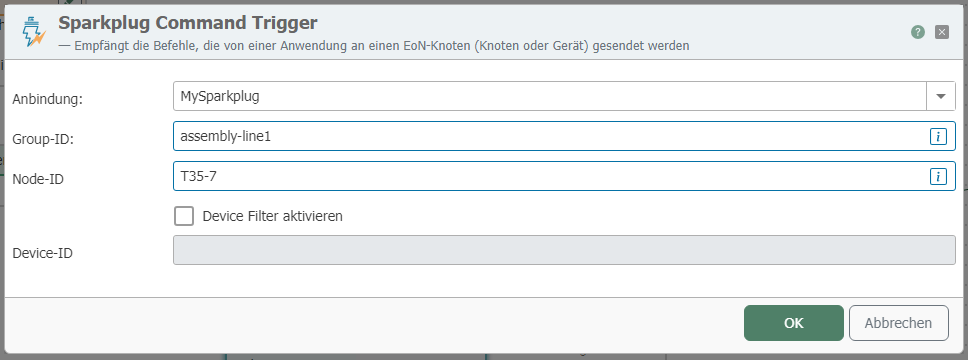
You can only select connections that were created for node profiles in the plug-in settings.
| Property | Description |
|---|---|
| Sparkplug Connection | Select a Sparkplug connection created under Plug-Ins |
| Group Filter | Specify a group filter for the trigger. Caution: The specified filters are of the string data type and search for identical ("equal") strings. |
| Node Filter | Specify a node filter for the trigger. Caution: The specified filters are of the string data type and search for identical ("equal") strings. |
| Device Filter | Specify a device filter for the trigger. Caution: The specified filters are of the string data type and search for identical (“equal”) strings. |
Interaction with the Sparkplug application
The section on sequence diagrams explains how to read this diagram.
The Sparkplug Command Trigger receives commands that an application sends via the MQTT broker to the EoN node operated by the OPC Router (in the Sparkplug B protocol, these are the message types NCMD for the node and DCMD for a device; these abbreviations come from the Sparkplug specification, not from engineering. The trigger then initiates the transfer and does not wait for its result; under no circumstances does it send an acknowledgment to the application. There is no return path to the application unless you configure it yourself: an additional transfer object named “Sparkplug Node Publish” in the same flow publishes values as NDATA or DDATA. This publication occurs in the middle of the flow, regardless of the transfer result and without reference to the triggering command.
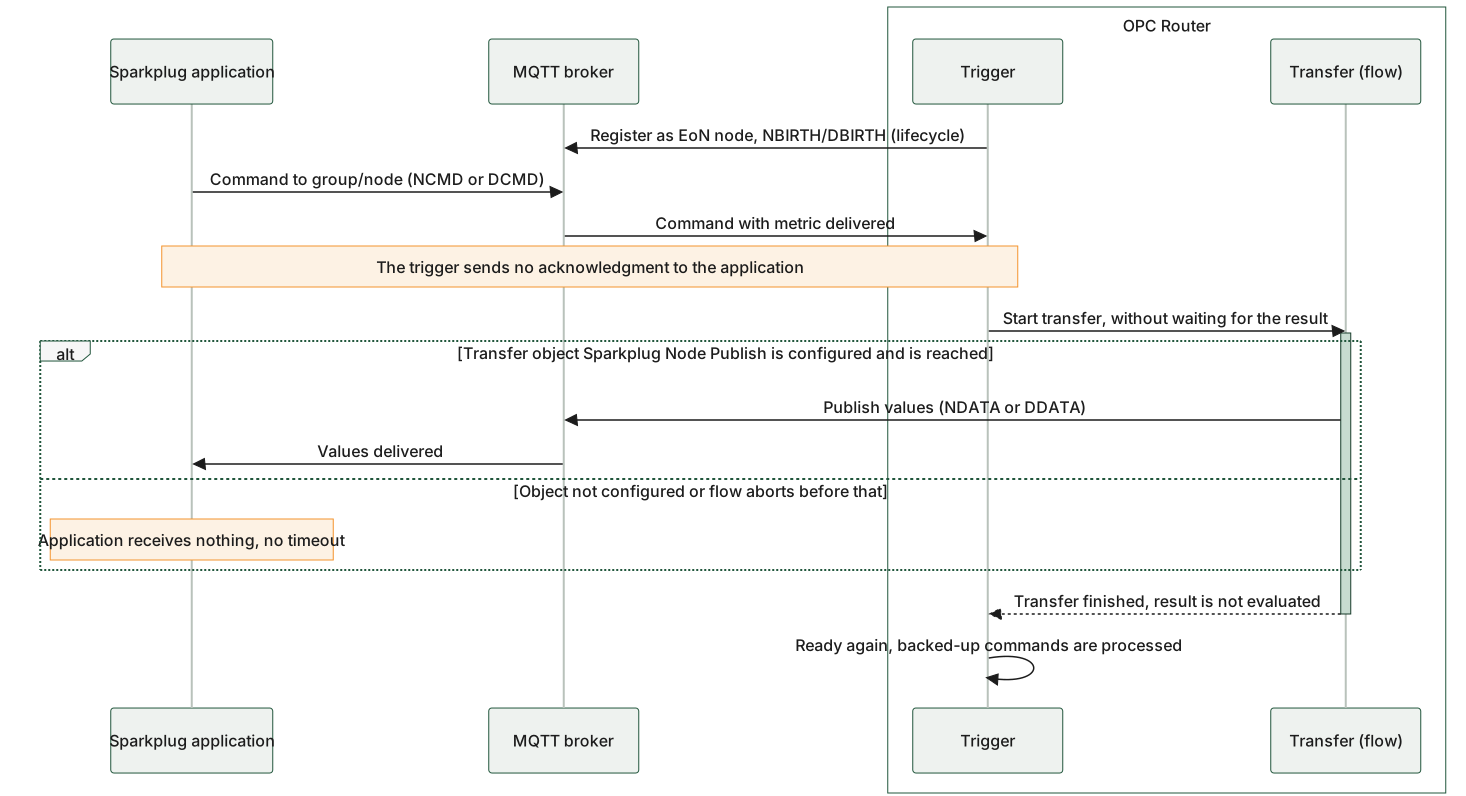
The diagram separates the command path from the response path. The command flows from the application through the broker to the trigger and from there to the transfer, without the trigger sending any response back. The only return path is the dashed branch via an additionally projected transfer object that is published in the middle of the flow; if this branch is omitted, the application receives neither a success nor an error notification.
The trigger never acknowledges the command; feedback to the application is provided only by an additional projected transfer object, “Sparkplug Node Publish,” which publishes in the middle of the flow and independently of the transfer result.